Genesis
Beginnings: creation, the fall, the flood, and the family of Abraham, Isaac, Jacob, and Joseph.
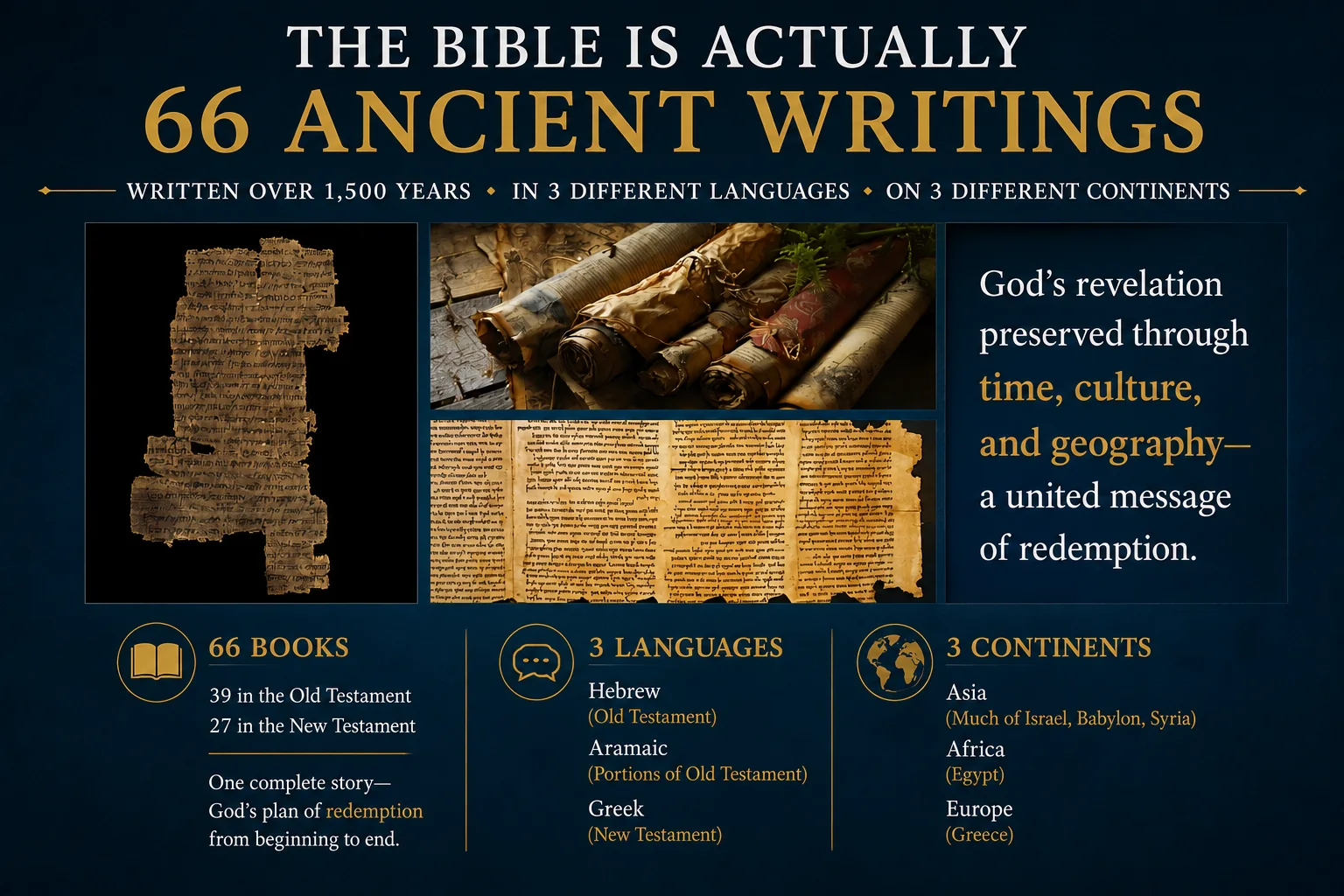
Who wrote each book by tradition, when, and where it fits in the story. All 66 books of the Protestant canon are placed here.
The first five books, Genesis through Deuteronomy, are also called the Torah or the Law. Jewish and Christian tradition ascribes them to Moses, while many scholars see a longer process of writing and editing. Each book’s page sets out both views.
Beginnings: creation, the fall, the flood, and the family of Abraham, Isaac, Jacob, and Joseph.
Israel’s rescue from Egypt, the covenant at Sinai, and the building of the tabernacle.
Laws for worship, sacrifice, priests, purity, and holy living, given at Sinai.
Israel’s census, forty years in the wilderness, and the approach to the promised land.
Moses’ farewell speeches on the plains of Moab, renewing the covenant before Israel enters the land.
Twelve books, Joshua through Esther, carry Israel’s story from the entry into Canaan to the Persian period. Most are anonymous, and several were put into their final form long after the events they describe.
Israel enters Canaan under Joshua and the land is divided among the tribes.
Israel’s cycle of falling away, oppression, and rescue by leaders from Othniel to Samson.
A Moabite widow stays loyal to Naomi and becomes the great-grandmother of David.
Samuel, the demand for a king, and the rise and fall of Saul alongside the rise of David.
David becomes king, makes Jerusalem his capital, receives God’s promise of a lasting dynasty, and falls into sin.
Solomon’s reign and the temple, the division of the kingdom in 931 BC, and the ministry of Elijah.
The kings of Israel and Judah, the fall of Samaria in 722 BC, and the fall of Jerusalem in 586 BC.
Genealogies from Adam to the returned exiles, followed by the reign of David and his preparations for the temple.
Solomon’s temple, the kings of Judah, the fall of Jerusalem, and the decree of Cyrus.
The first return from Babylon, the rebuilding of the temple, and Ezra’s reforms.
Nehemiah returns as governor, rebuilds Jerusalem’s wall, and leads the people in renewing the covenant.
A Jewish queen in Persia risks her life to save her people, remembered at the feast of Purim.
The five longer prophetic books are Isaiah, Jeremiah, Lamentations, Ezekiel, and Daniel. “Major” refers to length, not importance. Daniel stands among the Writings in the Hebrew Bible, and Lamentations, a set of poems traditionally linked to Jeremiah, is placed after Jeremiah in Christian Bibles.
Judgment and hope for Judah and the nations, and the promise of a coming king and servant.
Jeremiah warns Judah of Babylon’s coming judgment and promises a new covenant.
Five poems of grief over the destruction of Jerusalem in 586 BC.
A priest in exile in Babylon sees visions of God’s glory, judgment on Jerusalem, and hope for renewal.
Daniel and his friends serve in Babylon and Persia, and receive visions of the kingdoms of the world and God’s kingdom.
The twelve shorter prophetic books, Hosea through Malachi, were counted as one scroll, the Book of the Twelve, in Jewish tradition. They come from roughly the 8th to the 5th centuries BC, and the order in the Bible is only partly chronological.
Hosea’s marriage pictures God’s faithful love for unfaithful Israel.
A plague of locusts becomes a warning of the day of the Lord and a promise that God will pour out his Spirit.
A shepherd from Judah calls the northern kingdom to justice and warns of coming exile.
A short warning to Edom for turning against its neighbor Judah on the day of Jerusalem’s fall.
A reluctant prophet is sent to Nineveh and learns of God’s mercy to a foreign city.
Micah warns Samaria and Jerusalem of judgment and promises a ruler from Bethlehem.
A poem announcing the coming fall of Nineveh, the capital of Assyria.
Habakkuk questions why God allows injustice and receives the answer that the righteous will live by faith.
Zephaniah announces the day of the Lord for Judah and the nations, followed by restoration.
Haggai urges the returned exiles to rebuild the temple.
Visions and oracles encouraging the returned exiles, and promises of a coming king.
The last prophetic book of the Old Testament calls the priests and people back to covenant faithfulness.
Five books of the Protestant canon are usually grouped as wisdom and poetry: Job, Psalms, Proverbs, Ecclesiastes, and Song of Songs. They were not written at one time or place. Some are tied to David and Solomon (about 1000–930 BC), but the Psalms were gathered over many centuries and the date of Job is unknown.
A righteous man loses everything, and the book wrestles with why the innocent suffer.
One hundred fifty songs and prayers, gathered into five books over many centuries.
Short sayings and longer poems that teach how to live wisely before God.
The Teacher examines life “under the sun” and concludes that meaning is found in fearing God.
A poem of love between a man and a woman, celebrated in Jewish and Christian tradition.
The four Gospels tell the life, death, and resurrection of Jesus, and Acts tells how the church spread. All five books are anonymous, and the names attached to them come from early Christian tradition. Matthew, Mark, and Luke share much material, a relationship scholars call the synoptic problem.
The Gospel that presents Jesus as Israel’s Messiah, the son of David and of Abraham.
The shortest Gospel, a fast-moving account of Jesus’ ministry, death, and resurrection.
A careful account of Jesus’ life addressed to Theophilus, and the first volume of Luke–Acts.
The Gospel that presents Jesus as the Word made flesh and tells of signs written “that you may believe.”
The spread of the gospel from Jerusalem to Rome, the second volume of Luke–Acts.
Thirteen New Testament letters carry Paul’s name. Nearly all scholars accept seven as his: Romans, 1 and 2 Corinthians, Galatians, Philippians, 1 Thessalonians, and Philemon. Authorship of Ephesians, Colossians, 2 Thessalonians, and the Pastoral letters (1 and 2 Timothy and Titus) is debated. 1 Thessalonians, written about AD 50, is among the earliest.
Paul’s fullest explanation of the gospel, written to the church in Rome.
Paul answers divisions, disorder, and questions in the church at Corinth, in the Roman province of Achaia.
Paul defends his ministry and appeals to the Corinthians after a painful conflict.
Paul argues that Gentile believers are justified by faith, not by the works of the law.
Paul’s letter on God’s plan to unite all things in Christ and to make Jew and Gentile one church.
A warm letter to the church at Philippi in Macedonia, written from prison.
Paul warns the church at Colossae against false teaching and exalts the supremacy of Christ.
Paul encourages a young church in Thessalonica, the capital of Macedonia.
Paul corrects confusion about the day of the Lord and urges steadiness.
Instructions from Paul to Timothy about leading the church in Ephesus.
Paul’s last letter, written near the end of his life, urging Timothy to remain faithful.
Paul’s instructions to Titus for organizing the churches on the island of Crete.
A short, personal letter asking Philemon to welcome back Onesimus as a brother.
Hebrews and the letters of James, Peter, John, and Jude were addressed to wider audiences than one church. Hebrews is anonymous, and authorship of several of the others is debated.
A sermon-like letter arguing that Jesus is greater than the prophets, angels, Moses, and the priests.
Practical teaching on faith that acts, speech, wealth, and endurance.
Peter encourages scattered believers in Asia Minor to endure suffering and live as God’s people.
A farewell letter warning against false teachers and encouraging patience until Christ’s return.
A letter on assurance, love, and truth, written against those who denied that Jesus came in the flesh.
A short letter from “the elder” warning a church against teachers who deny Jesus’ humanity.
A personal note from “the elder” praising Gaius and warning of Diotrephes.
A short letter urging believers to contend for the faith against false teachers.
The last book of the Bible is a prophecy in the style of apocalyptic writing, addressed to seven churches in Asia Minor.
John’s vision on Patmos, addressed to seven churches, of Christ’s victory and the new creation.