Step one sounds simple: read what the passage actually says. To do that well, it helps to know what you're holding, how it got to you, and how to read it. That's this page.
It's a library, not one book
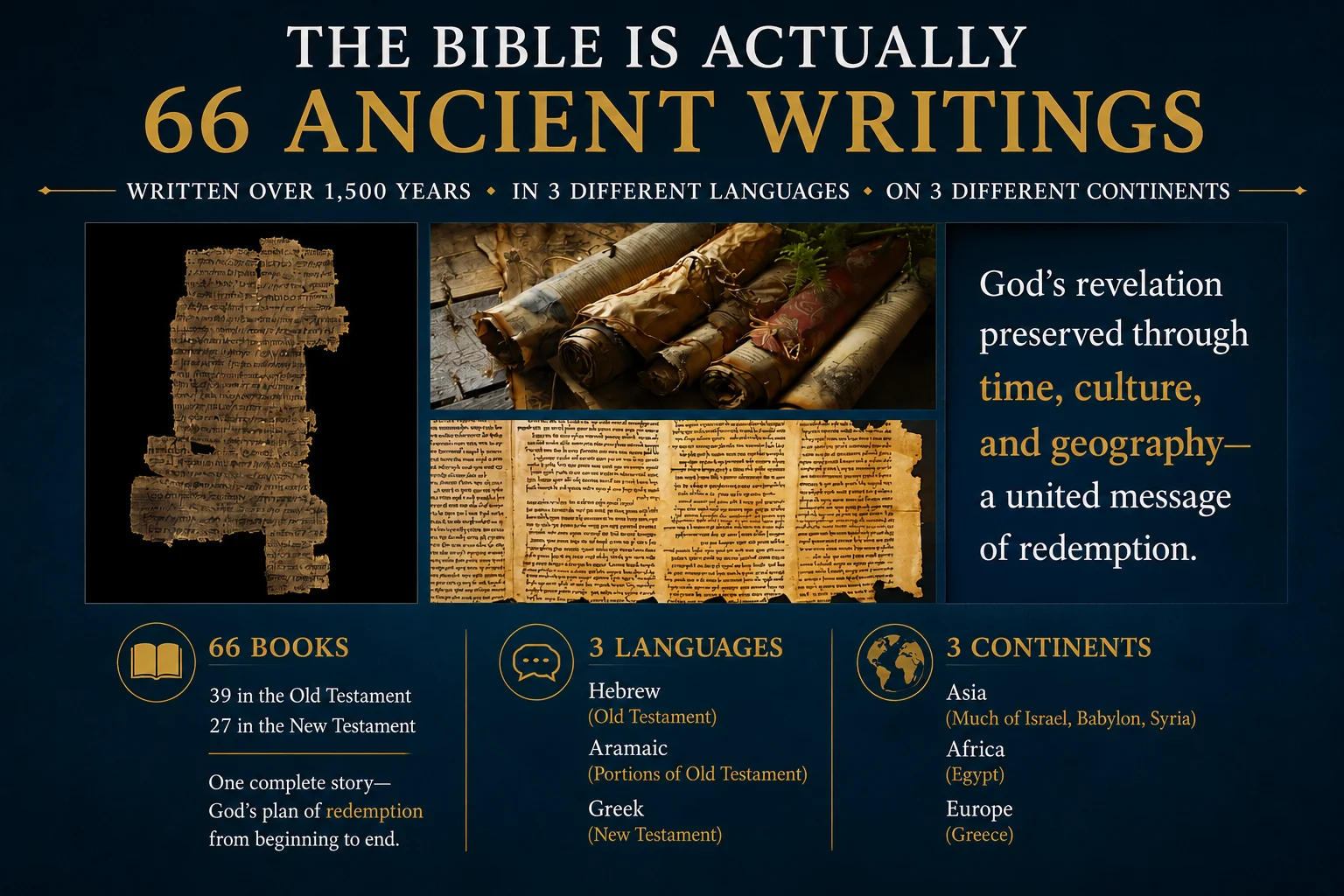
The Bible is 66 ancient writings: 39 in the Old Testament and 27 in the New.
That's the Protestant count. Other Christians count more books. See "Where Christians differ" below.
It was written in three languages. Most of the Old Testament is Hebrew. A few chapters of Daniel and Ezra are Aramaic. The New Testament is Greek.
It had many authors. Tradition counts about 40. Many books never name their author, and scholars often see more hands at work, including editors who put older material together.
It was written over a long time. Traditionally, from Moses to Revelation, that's about 1,500 years. Scholars debate the dates of some books. Either way, it's a long time for one story to hold together.
And the story covers a lot of ground. It happens on three continents. Joseph is sold as a slave into Egypt (Genesis 37:28). Centuries later, Jeremiah is taken to Egypt and keeps preaching there (Jeremiah 43:5–7). Joseph and Mary flee to Egypt with the young Jesus, and Matthew quotes the prophet: "Out of Egypt I called my son." (Matthew 2:15, WEB) Then Paul crosses into Europe (Acts 16:9–12). That's Asia, Africa, and Europe.
Different kinds of writing
The Bible holds law, history, poetry, wisdom, prophecy, gospels, letters, and apocalypse. You don't read a love poem the way you read a tax law. You don't read a psalm the way you read one of Paul's letters.
The Books of the Bible page groups all 66 by kind. For each one it gives who wrote it by tradition, when, and what scholars debate.
How the books were gathered
Nobody sat down one day and picked 66 books. And no, the Council of Nicaea didn't do it. It never discussed the list.
The Hebrew books came together over centuries. The Law came first. The Prophets were known as a group by around 200 BC. The rest stayed open longer. Rabbis were still arguing about Song of Songs and Ecclesiastes after the church began. Nobody argued about Isaiah.
The New Testament books were used first and listed later. Paul's letters were already being passed between churches:
"When this letter has been read among you, cause it to be read also in the assembly of the Laodiceans, and that you also read the letter from Laodicea." (Colossians 4:16, WEB)
Around AD 325, the historian Eusebius sorted the books in the open: accepted, disputed (James, Jude, 2 Peter, 2 and 3 John), and rejected.
The first list that matches our 27 exactly comes from Athanasius in AD 367. If I'm going to quote him, you should hear the rest. His Old Testament list matches nobody's Bible today. And he left out Esther. He put it in a second group: books good for new believers to read, but not on the list. So no, the church didn't settle on 66 and stop arguing.
A popular book called the Shepherd of Hermas was left out for being too recent. The same ancient list that leaves it out says it should still be read.
I'll concede one thing. Fitting the church's faith was one of the tests used. I take that objection head-on in question 4 on the Honest Questions page.
How it was copied
Every Bible before printing was copied by hand. The text itself shows books being written and rewritten. When a king burned Jeremiah's scroll:
"Then Jeremiah took another scroll, and gave it to Baruch the scribe, the son of Neriah, who wrote therein from the mouth of Jeremiah all the words of the book which Jehoiakim king of Judah had burned in the fire; and many similar words were added to them." (Jeremiah 36:32, WEB)
The Old Testament. The oldest complete Hebrew Bible is the Leningrad Codex, copied in AD 1008.
It comes from a line of Jewish scribes called the Masoretes, who worked from about AD 500 to 1000. They didn't just copy. They counted. At the end of a book they recorded how many verses, words, and letters it had, and where its middle was. A bad copy could be caught.
Here's the telling detail. When the letters in front of them looked wrong, they didn't fix them. They copied the letters exactly as written and put the way to read it aloud in the margin. Scholars call these the ketiv ("what is written") and the qere ("what is read"). These scribes would rather pass on what looked like a mistake than quietly improve the Bible. People hiding changes don't build a system like that.
Then, in the late 1940s and 1950s, the Dead Sea Scrolls turned up. They include every Old Testament book except Esther. The Great Isaiah Scroll is from about the second century BC, roughly a thousand years older than the Leningrad Codex.
It agrees with the medieval text in content, order, and sense. It differs in spelling, and in wording at a known, published set of places. At Isaiah 53:11, the scroll has "he will see the light." The medieval text doesn't have "light." Modern translations changed to follow the scroll, and the WEB on this site does too. Nobody hid that.
The scrolls also show some books existed in more than one edition. Jeremiah circulated in a short form and a long form.
The Hebrew Bible reached Christians through Jewish scribes who didn't read Isaiah the way Christians do. They kept it anyway. The Samaritans, split from Jerusalem for centuries, kept their own copy of the five books of Moses, which cross-checks it.
The New Testament. You'll hear there are about 5,700 Greek manuscripts. That's a real count. But 94 percent were copied after the ninth century. The early pile is smaller: papyrus fragments, most from the third century or later, and complete Bibles from the fourth. The oldest scrap is a piece of John, dated to the second century.
The copies differ in many small ways, more differences than there are words in the New Testament. Almost all are spelling and slips of the pen. A few are big. The long ending of Mark (16:9–20), the woman caught in adultery (John 7:53–8:11), and the Trinity line older English Bibles have at 1 John 5:7 were probably not in the originals. Your Bible's footnotes already tell you this.
Daniel Wallace, an evangelical scholar who studies these manuscripts, says we can't recover every word the authors wrote. He also says the text is secure in all essentials, so there's no need to be overly skeptical. Both halves are his.
So here's what I claim, and where it stops. We can rebuild what the authors wrote with high confidence. Where we can't, we know where, and the options are printed for anyone to check. That doesn't prove the Bible is true. It means you're reading the real claim, not something made up later. That's the door. It isn't the room.
Go deeper: Session 12, the class session on the groups that shaped and preserved the text.
About translations
Every English Bible is a translation. Nobody reads the originals in English.
Translators start from the best Hebrew and Greek texts we have. For the Old Testament, that's the Leningrad Codex, the base of nearly every modern translation. For the New Testament, it's printed Greek editions that compare the manuscripts and list the differences right on the page.
Then they make a choice. Some stay close to the original wording, even when the English reads stiff. Others aim for the plain sense in natural English. Some paraphrase freely. Each choice gains something and loses something. They're making different trade-offs, not cheating.
You've already seen one on this page. In Colossians 4:16, the WEB says "assembly." Most English Bibles say "church." It's the same Greek word, translated two ways.
This site quotes the World English Bible (WEB). It's public domain, so we can show every verse word for word without asking anyone's permission. We show its words unchanged. We don't show its footnotes or section headings.
So here's my advice. When a verse really matters, read it in a second translation and check the footnotes. The footnotes are where translators tell you about the manuscript differences above. Two good translations that disagree are telling you where to slow down.
What the Bible says about itself
The Bible makes claims about itself. Here are a few, plainly labeled as how Christians read them.
Paul writes:
"Every Scripture is God-breathed and profitable for teaching, for reproof, for correction, and for instruction in righteousness" (2 Timothy 3:16, WEB)
Christians read that as a claim that God stands behind Scripture.
Peter says the prophets didn't make it up:
"knowing this first, that no prophecy of Scripture is of private interpretation. For no prophecy ever came by the will of man, but holy men of God spoke, being moved by the Holy Spirit." (2 Peter 1:20–21, WEB)
Notice the two halves. Men spoke. God moved them. The Bible doesn't present itself as a book that fell from the sky. Real people wrote it. Luke, below, even tells you he did research.
It also says what it's for. John wrote "that you may believe that Jesus is the Christ, the Son of God, and that believing you may have life in his name" (John 20:31, WEB). A psalm puts it more simply: "Your word is a lamp to my feet, and a light for my path." (Psalm 119:105, WEB) It's meant to be lived, not just studied.
Now, a fair point. A book can claim anything about itself. These verses don't prove anything on their own. That's why the order matters: first check that you're reading what was actually written, then decide whether to believe it. What I take inspiration to mean, and what I don't, is on the Honest Questions page.
How to read a passage
This is the core of step one. Six habits:
- Read the whole section, not one verse. A verse pulled out alone can be made to say almost anything.
- Name the kind of writing. Poem, law, story, letter, or vision?
- Ask who, to whom, and when. The book's page will tell you.
- Watch the structure. Repeated words, turns, and every "therefore."
- Write down what it claims in your own words, before deciding what it means.
- Separate what it says from what you've been told it says.
The Bible models this. When Ezra read the Law to the people, "They read in the book, in the law of God, distinctly; and they gave the sense, so that they understood the reading." (Nehemiah 8:8, WEB)
Try it on Luke 1:1–4. Luke tells you his own method. Others had written accounts. Eyewitnesses handed the material down. Then:
"it seemed good to me also, having traced the course of all things accurately from the first, to write to you in order, most excellent Theophilus; that you might know the certainty concerning the things in which you were instructed." (Luke 1:3–4, WEB)
Who's writing? A careful collector. To whom? One man, Theophilus. Why? So he'd know for certain. You just read the text before interpreting it.
Our faith invites you to question it. The people of Berea did, "examining the Scriptures daily to see whether these things were so." (Acts 17:11, WEB)
Where to go next
Next step: The Story. The text carries a story. Step two asks where a passage fits among the people, places, and events of the whole Bible.